Why Is Your Pitaya Yield Low? - How LED Grow Lights Can Increase Production by Over 80%
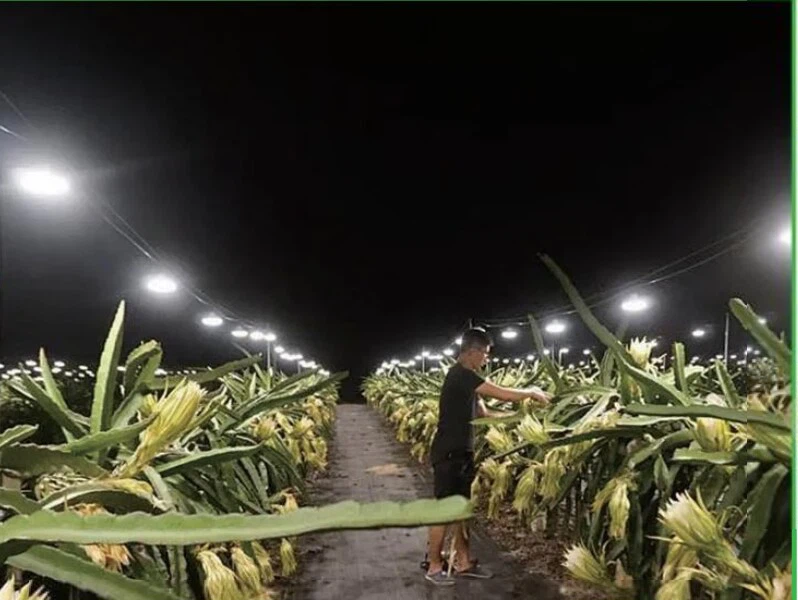
In northern solar greenhouses, pitaya often suffers from insufficient light, leading to poor flowering and low fruit set. As a long-day plant, pitaya requires nearly 12 hours of daylight to properly initiate flower buds. The natural short days in spring and autumn are the main bottleneck limiting yield. LED grow lights offer a scientific, efficient, and cost-effective solution.
1. LED Lights: Not Just "Brighter is Better" - Focus on Three Key Parameters
Pitaya is sensitive to light quality (wavelength). Different light colors have very different effects. Below are the technical parameters of four LED lights tested in the study:
| LED Code | Dominant Wavelength (nm) | Luminous Flux (Lm) | Power (W) | Luminous Efficacy (Lm/W) | Light Characteristics |
|---|---|---|---|---|---|
| L1 (recommended) | 596.1 | 1485.67 | 15 | 99.05 | Orange light, high flux |
| L2 | 562.1 | 1439.01 | 15 | 95.93 | Yellow-green |
| L3 | 699.9 | 851.79 | 9 | 94.64 | Red light, lowest power |
| L4 | 582.3 | 1360.50 | 15 | 90.70 | Yellow light |
| CK (no supplement) | - | - | - | - | Natural light |
Key findings:
- Higher efficacy = more energy saving: L1 offers 99.05 Lm/W, giving more light per watt.
- Dominant wavelength around 590–600 nm (orange light) is most effective for promoting flowering.
- Higher luminous flux ensures better coverage - L1 has the highest flux.
2. How Many More Fruits Can You Get with LED Lighting?
The trial used an imported premium variety "Israel Yellow Dragon (thornless yellow pitaya)" . Data from the 4th flowering batch in spring are compared below:
| LED Treatment | Fruits per Plant | Avg. Fruit Weight (g) | Yield per Plant (kg) | Yield Increase (%) |
|---|---|---|---|---|
| L1 | 7.37 | 382.93 | 2.82 | 80.85% |
| L2 | 7.32 | 381.24 | 2.79 | 80.64% |
| L3 | 6.40 | 370.50 | 2.37 | 77.22% |
| L4 | 7.31 | 374.95 | 2.74 | 80.29% |
| CK (no light) | 1.40 | 385.15 | 0.54 | -- |
What this means:
- Fruits per plant increased from 1.4 to up to 7.37 - more than 5×.
- Yield increase up to 80.85% - a field that produced 100 kg now produces over 180 kg.
- Average fruit weight did not drop, showing that lighting boosts flower buds without sacrificing fruit size.
3. Spring & Autumn Lighting Strategies: Earlier Harvest + Extended Season
| Season | Lighting Period | Daily Schedule | Effect |
|---|---|---|---|
| Spring | Feb 2 – Apr 15 | 18:00 – 22:00 | First flowering as early as March, adding 4–5 fruit batches |
| Autumn | Aug 15 – Oct 15 | 19:00 – 23:00 | Last flowering delayed to late November, adding 1–2 batches |
Without supplemental light, the first mass flowering occurs in early May. With LED lighting, flowering starts in late March - over 40 days earlier, capturing premium market prices.
4. Does Sugar Content Drop? - Brix Data Eases Concerns
Many worry that higher yields might reduce sweetness. The study measured fruit Brix (total soluble solids, ≈ sugar content ×0.8):
- Brix with LED lighting: 19.21% – 20.37%
- Brix without lighting: ~20.5% (slightly higher, but not statistically significant)
Conclusion: LED lighting does not negatively affect sugar accumulation. The minor variation is due to nutrient dilution from higher fruit load, which can be managed with proper fertilization.
5. Recommendations for Choosing LED Lights
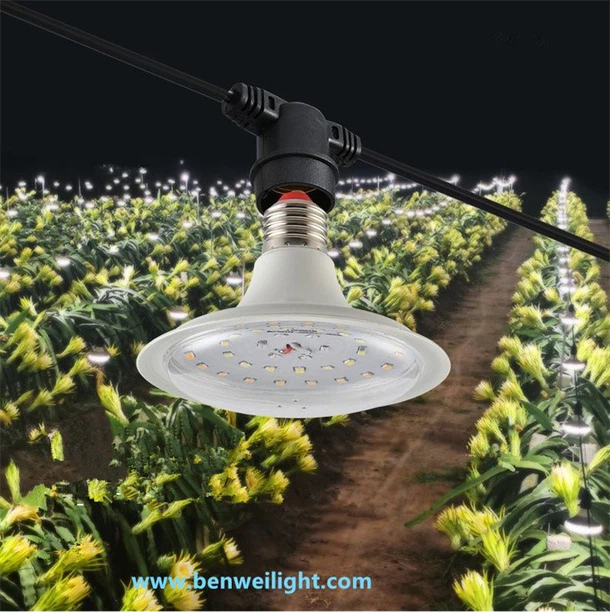
Based on the trial data, growers should prioritize:
- Light quality: Dominant wavelength 590–600 nm (orange light) is best - like L1.
- Luminous efficacy ≥ 95 Lm/W for energy savings.
- Luminous flux ≥ 1400 Lm to ensure full canopy coverage.
- Installation height: 80–100 cm above plant canopy, with 1.5 m spacing between lights.
- Lighting schedule: 4 hours per day - 18:00–22:00 in spring, 19:00–23:00 in autumn.
In one sentence: Choose the right LED lights, and your pitaya can go from "two batches a year" to "seven batches a year" - doubling your yield is not a dream.
For more information on specific products or customized lighting solutions, feel free to contact us.