Does Turning an LED On and Off Reduce Its Lifespan? The Truth About LED Switching Durability
Introduction: Debunking the Myth of LED Wear-and-Tear
A common concern among LED users is whether frequent switching affects bulb longevity. Unlike traditional incandescent bulbs that clearly wear out from cycling, LED technology behaves differently. This article examines:
✔ How LED switching actually impacts lifespan
✔ Scientific comparisons with traditional lighting
✔ Real-world case studies of extreme cycling tests
✔ Best practices for maximizing LED durability
Understanding this topic helps consumers and businesses optimize their lighting usage without unnecessary fear of premature failure.
1. The Fundamental Difference: Why LEDs Handle Switching Better
Physics of LED Degradation
LEDs are solid-state devices with no fragile filaments or glass components. Their lifespan depends primarily on two factors:
Junction temperature (heat at the semiconductor layer)
Electron migration over thousands of hours
Unlike incandescent bulbs that fail from thermal shock during cycling:
LEDs experience minimal stress from on/off cycles
The main wear mechanism is total operational hours, not switching frequency
Comparative Failure Mechanisms
| Bulb Type | Primary Failure Cause | Cycling Sensitivity |
|---|---|---|
| Incandescent | Filament fracture | High |
| CFL | Electrode degradation | Moderate |
| LED | Phosphor/LED chip aging | Very Low |
2. Laboratory Evidence: What Controlled Tests Reveal
UL Certification Standards
Under UL 1993 testing requirements:
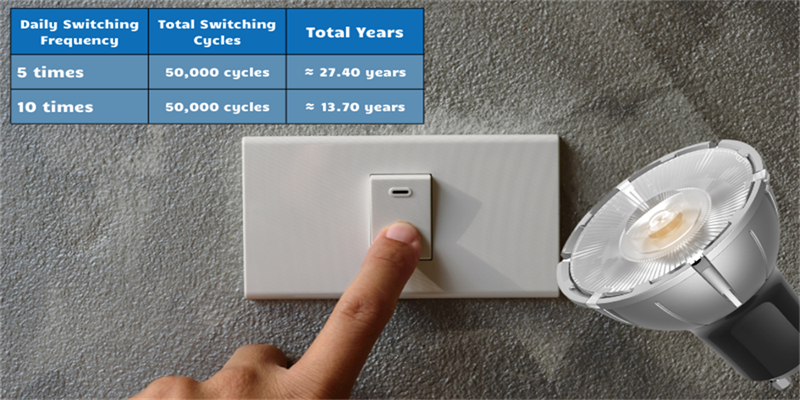
LEDs must withstand minimum 15,000 cycles (on for 1 min, off for 3 min)
High-quality LEDs often exceed 50,000-100,000 cycles
Extreme Case Study: The Rapid Cycling Test
A 2018 study by the Lighting Research Center:
Tested commercial LEDs under 5-second on/off cycles
Results after 500,000 cycles (equivalent to 57 years of hourly switching):
No catastrophic failures
<3% lumen depreciation
Color shift within acceptable limits
3. Real-World Applications: Where Frequent Switching Occurs
Residential Examples
Motion-Activated Lights (e.g., closets, bathrooms):
Average 20-50 cycles/day
High-quality LEDs last 7+ years in these applications
Smart Lighting Systems:
Some IoT-controlled lights cycle 100+ times daily
Philips Hue tests show no reduced lifespan vs continuous operation
Commercial/Industrial Cases
Traffic Signals:
Cycle every 30-90 seconds
Last 5-7 years (vs 6-12 months for incandescent)
Retail Display Lighting:
Motion-activated case lighting
Case Study: IKEA reported 60% maintenance reduction after LED conversion
4. The Minor Impact That Does Exist: Understanding the 1% Factor
While LEDs handle cycling exceptionally well, two subtle effects may occur:
Thermal Expansion Micro-Stress:
Each cycle causes microscopic material expansion/contraction
Estimated to reduce lifespan by <1% per 10,000 cycles
Driver Circuit Wear:
The weakest link is often the power supply
Cheap drivers may fail from capacitor stress during cycling
Comparative Impact Table
| Factor | Incandescent | CFL | LED |
|---|---|---|---|
| Lifespan reduction per 1,000 cycles | 5-10% | 1-2% | <0.1% |
| Primary cycling failure point | Filament | Ballast | Driver (if poor quality) |
5. Manufacturer Specifications: What the Data Sheets Say
Leading LED manufacturers specify:
Philips: "On/off cycling has negligible effect on rated lifespan"
Cree: "Our LEDs withstand 50,000+ cycles without degradation"
Osram: "Cycling impacts are factored into our 50,000-hour ratings"
Warranty Analysis
Most premium LED warranties:
Cover both hours and years (e.g., 50,000 hours/5 years)
Don't exclude frequent cycling scenarios
6. Best Practices for Different Use Cases
When to Freely Cycle LEDs
✔ Motion sensors
✔ Occupancy-controlled lighting
✔ Daylight harvesting systems
✔ Smart home automation
When to Consider Continuous Operation
✔ High-vibration environments (industrial)
✔ With ultra-cheap, uncertified LEDs
✔ In extreme temperatures (<-20°C/>50°C)
Prolonging LED Life in Cycling Applications
Choose dimmable LEDs instead of full on/off when possible
Select thermally managed fixtures for high-cycle environments
Invest in quality drivers (look for IEC 62384 compliance)
7. Economic Analysis: Cycling vs Continuous Operation
Energy Savings vs Potential Wear
Scenario: Office bathroom light (15W LED)
Option 1: Motion-activated (40 cycles/day)
Annual cycles: 14,600
Estimated lifespan impact: <2%
Energy savings: ~70%
Option 2: Continuous operation
No cycling impact
Wastes $18/year in electricity
Burns hours unnecessarily
Conclusion: The energy savings overwhelmingly justify cycling.
8. Future Developments: Even More Resilient LEDs
Emerging technologies further reduce cycling impacts:
GaN-on-GaN LEDs (more thermally stable)
Solid-state drivers (no electrolytic capacitors)
Self-healing phosphors under development
Conclusion: Switch Without Worry
Scientific evidence and real-world experience confirm:
✅ Quality LEDs suffer negligible lifespan reduction from normal cycling
✅ The energy savings from smart switching far outweigh any minimal wear
✅ Only ultra-cheap LEDs with poor drivers show cycling sensitivity
Recommendations:
Don't avoid cycling LEDs - it's one of their key advantages
Invest in reputable brands for high-cycle applications
Take full advantage of motion sensors and smart controls
The LED's ability to withstand frequent switching is yet another reason it dominates modern lighting solutions. Use this capability to maximize both energy efficiency and convenience in your home or business.