How Do LED Lights Truly Regulate Greenhouse Plant Growth?
In traditional greenhouse cultivation, supplemental lighting is often simplified as "turn on the lights when it gets dark." But plants' response to light goes far beyond "whether there is light"-they use a sophisticated photosensory system to read light's wavelength, intensity, duration, and rhythm of change, and based on this decide when to grow leaves, when to flower, and when to accumulate sugars. The fundamental reason LED grow lights are replacing high-pressure sodium lamps as the mainstream choice for greenhouse supplemental lighting is that they give growers, for the first time, the ability to "communicate precisely" with the plant photoreceptor system.
The Way Plants "See" Light Determines What LEDs Can Do
Plants contain multiple photoreceptor proteins, including phytochromes, cryptochromes, and phototropins. These receptors respond very differently to different wavebands: blue light (400–500 nm) mainly drives leaf expansion and stomatal opening, red light (600–700 nm) promotes stem elongation and biomass accumulation, while far-red light (700–750 nm) participates in seed germination and flowering regulation. What makes LEDs unique is that they can precisely control the output ratio of each waveband through narrow-band emitters, and even dynamically switch spectral combinations at different growth stages.
This means a good LED grow light is no longer an "illumination tool" but a "light environment control terminal." For example, with greenhouse tomatoes, increasing the blue-light ratio during the seedling stage helps produce compact seedlings with thick stems; after entering flowering and fruit set, the red-to-blue ratio can be adjusted to 3:1 or even higher to promote fruit expansion and sugar accumulation. The flexibility of LEDs allows the same set of fixtures to serve different needs throughout the plant's entire life cycle without changing hardware.
Three Levels of Greenhouse Supplemental Lighting: From "Enough" to "Precise"
LED applications in greenhouses can be divided from low to high into three levels, corresponding to different cultivation goals and investment levels.
Level One: Photoperiod Regulation. This is the most basic use. For photoperiod-sensitive crops, LED lights are used for day extension or night interruption when natural daylength is insufficient, in order to regulate flowering time. For example, when growing long-day flowers in short-day seasons, only a few hours of low-intensity light after sunset is needed to trigger the flowering response. Studies have shown that low-intensity blue light or end-of-day supplemental lighting with blue light + far-red light can effectively regulate flowering and plant architecture in potted ornamental plants.
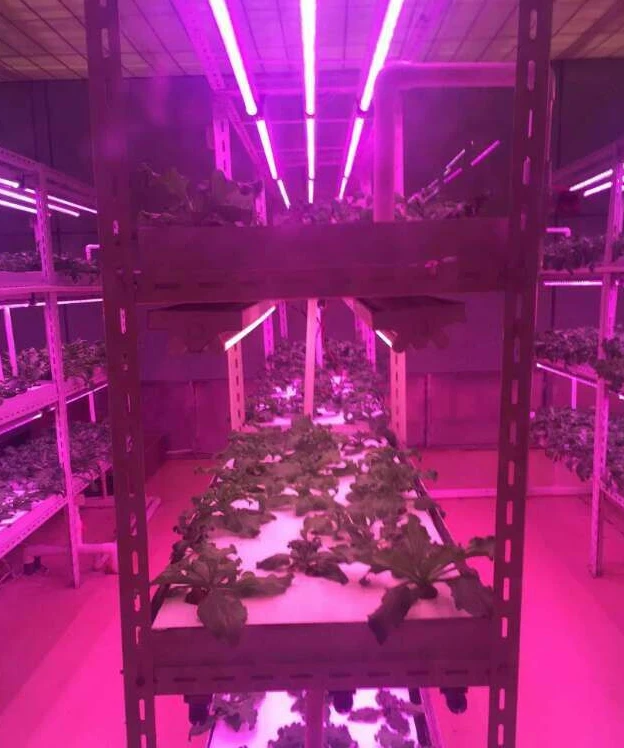
Level Two: Photosynthetic Supplementation. This is the most common scenario for greenhouse supplemental lighting. In winter or during rainy and cloudy seasons, when the photosynthetic photon flux density of natural light is insufficient, LED lights provide additional high-intensity light to maintain the photosynthetic rate. The key metric here is the PPFD received at the canopy-under different installation heights for the same fixture, the number of photons plants actually "eat" can differ several times over. In greenhouses, it is usually recommended to hang fixtures 30–60 cm above the top of the canopy, with fine-tuning according to crop type.
Level Three: Dynamic Spectral Control. This is the core advantage that distinguishes LEDs from all traditional light sources. Through fixtures with adjustable spectra, growers can change the spectral recipe within a day or even from day to day. For example, during afternoons with abundant light, a spectrum with a higher far-red ratio can be used to promote stem extension, while in the early morning and evening, a spectrum with a higher blue-light ratio can be used to inhibit excessive elongation. This degree of refinement in "light recipes" is completely impossible with high-pressure sodium lamps or fluorescent lamps.
Different Crops, Different "Light Preferences"
The effect of LED supplemental lighting is highly dependent on crop type. Take several common greenhouse crops as examples:
Strawberries are one of the crops that benefit most significantly from greenhouse supplemental lighting in winter and spring. A solar greenhouse trial by the Chinese Academy of Agricultural Sciences showed that when LED supplemental lighting began at the early stage of flower bud differentiation, all supplemental lighting treatments increased strawberry yield and advanced the harvest period by about 10 days. Among them, the treatment with a red-to-blue light ratio of 9:1 had the best yield increase, reaching 55.9%. Notably, the electrical energy use efficiency of a dynamic supplemental lighting strategy-switching lights on and off according to changes in natural light intensity-was 2.6 times that of a continuous supplemental lighting strategy, indicating that "supplementing smartly" is more cost-effective than "supplementing all the time."
Tomatoes and cucumbers and other fruiting vegetables tend to prefer a high proportion of red light. Studies show that in greenhouse supplemental lighting, 100% red light is more effective for cucumber seedlings than adding blue light. This is consistent with the high red-light demand of fruiting vegetables during the reproductive stage-red light directly promotes the accumulation of photosynthetic products and their transport to the fruit.
Leafy vegetables such as lettuce and spinach have a relatively higher demand for blue light, because blue light drives leaf unfolding and expansion of leaf area, helping plants capture more light energy in a limited space.
Selection and Installation: Practical Considerations
When actually deploying a greenhouse LED supplemental lighting system, in addition to the spectral recipe, several engineering factors directly affect performance and long-term cost.
Waterproof rating is an underestimated key indicator. Greenhouse humidity is usually maintained at 70%–95% RH, and water droplets continuously condense on the surface of fixtures. IP65, protected against water jets, is suitable for general greenhouses, while in hydroponic systems and greenhouses that require high-pressure washing, IP67, protected against short-term immersion, is a safer choice. In fixtures with insufficient waterproof ratings, under long-term high-humidity conditions, moisture will slowly seep in through seams, causing LED chip oxidation and driver power supply corrosion, shortening service life.
Installation height determines the actual amount of PPFD delivered. The closer the fixture is to the canopy, the higher the photon density reaching the leaves, but the smaller the coverage area; the farther away it is, the better the coverage uniformity, but the intensity attenuation is obvious. Based on the top of the canopy, an initial height of 30–60 cm is generally recommended, with specific adjustment according to fixture power and crop canopy structure. For tall crops such as tomatoes, interlighting between plants is also an effective means of improving the photosynthetic efficiency of lower leaves.
The long-term accounting of energy efficiency. The initial investment in LED fixtures is usually 3–4 times that of high-pressure sodium lamps, but LEDs have much higher electro-optical conversion efficiency than traditional fixtures and a lifespan of up to 50,000 hours, while high-pressure sodium lamps usually need to be replaced every 1–2 years. In continuously operating greenhouses, the cumulative cost of LEDs will fall below that of high-pressure sodium lamps after a few years, and the electricity and maintenance savings thereafter become net gains.
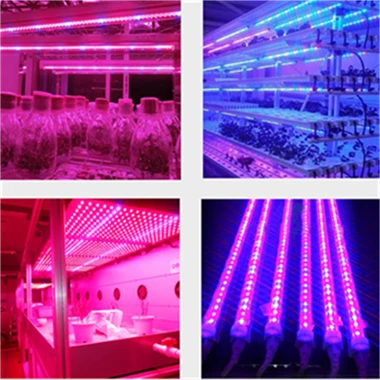
Back to the Product Itself
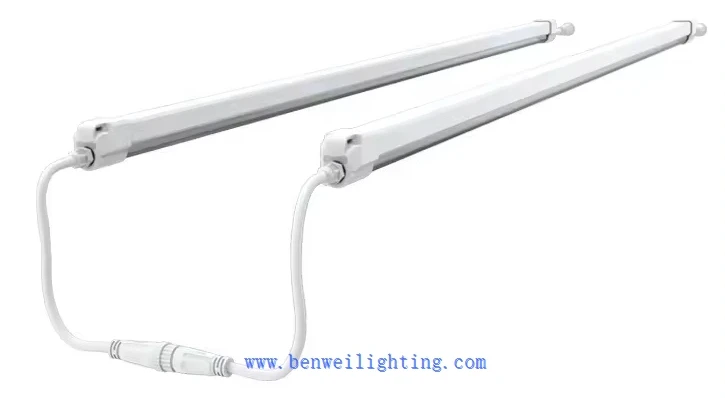
Take Benwei's greenhouse plant LED light as an example. Its full-spectrum output covers key wavebands from blue light to far-red light, and it supports brightness adjustment and timing functions, allowing growers to flexibly adjust the light environment according to different crop varieties and growth stages. Its IP65 protection rating and 50,000-hour service life also enable it to adapt to long-term continuous operation in high-humidity greenhouse environments. For greenhouse operators hoping to upgrade from traditional supplemental lighting solutions to LED solutions, this type of product provides a transition path from "using light" to "using the right light."
The essence of plant growth is a series of light-driven biochemical reactions. The significance of LED supplemental lighting is not to use artificial light to "replace" the sun, but to "fill in" when natural light is insufficient, with a spectrum and rhythm closest to the needs of plants. Once this is understood, the approach to choosing and using LED grow lights will shift from "buying a light that is bright enough" to "designing a light environment for my crop."
Inquiry
If you are looking for suitable LED grow lights for your greenhouse, or wish to customize a spectrum and supplemental lighting plan based on crop variety, greenhouse area, natural light conditions, and target yield, you are welcome to contact the Benwei team to submit an inquiry.
Please visit the product page:
https://www.benweilight.com/professional-lighting/led-grow-light/grow-light-for-green-houses-plants.html
In your inquiry, you can provide the following information so that we can recommend a suitable solution more quickly:
- Crop type and growth stage
- Greenhouse area and structure height
- Current natural light conditions and supplemental lighting goals
- Desired installation method and control method
- Purchase quantity and project location
Welcome to request a quote, samples, spectral customization recommendations, and greenhouse LED supplemental lighting selection support.