Professional Definition: Lifespan and Light Attenuation of Commercial LED Grow Tubes
Industrial Standard of LED Grow Tube Service Life
Unlike ordinary civilian lighting fixtures, the lifespan definition of commercial LED grow lights strictly follows horticultural lighting industry standards, focusing on effective photosynthetic light output rather than simple lighting duration. The industry universally adopts the L70 lifespan standard, which refers to the cumulative working hours when the lamp's luminous flux and photosynthetic photon flux drop to 70% of the initial factory state. For commercial agricultural planting, L70 is the true effective service life, because once the light output decays beyond 30%, the light energy can no longer meet the stable photosynthetic needs of crops, leading to reduced growth rate, decreased yield, and poor crop quality.
Our commercial T8 full-spectrum LED grow tube strictly implements industrial-grade L70 lifespan certification, with a rated effective service life of 50,000 hours. Calculated based on the commercial standard photoperiod of 16 hours of daily supplementary light, the lamp can operate stably for more than 8 consecutive years; even under ultra-high load 24-hour continuous planting operation, it can maintain effective photosynthetic light output for more than 5.5 years, completely meeting the long-cycle and high-intensity operation needs of vertical farms, commercial greenhouses, and seedling breeding bases.
Core Principle and Classification of LED Light Attenuation
Light attenuation, also known as luminous decay, refers to the gradual decline of LED chip light intensity and photosynthetic photon flux with the increase of working time. It is an inevitable physical aging phenomenon of LED lighting equipment, but the decay rate directly determines the service quality and service life of commercial grow lights. For horticultural lighting, light attenuation is far more harmful than lamp failure. Sudden lamp damage can be replaced in time to avoid planting losses, while slow and invisible light decay will lead to long-term insufficient light energy, resulting in slow crop growth, low germination rate, reduced flowering and fruiting rate, and hidden yield losses that are difficult for growers to detect in time.
Light attenuation of commercial LED grow tubes is divided into three core types. The first is thermal-induced light decay, which is the main cause of rapid aging of low-quality grow lights. Long-term high-temperature operation leads to the aging of LED chip luminescent materials and packaging glue, reducing luminous efficiency. The second is environmental-induced light decay. Commercial planting environments are usually high in humidity and prone to dust accumulation. Unsealed lamp bodies easily absorb moisture and dust, causing chip circuit oxidation and light transmittance decline. The third is current-induced light decay. Unstable drive current leads to frequent surge impact on chips, accelerating chip aging and light output attenuation.
Most ordinary commercial grow tubes on the market have no targeted anti-attenuation design for planting scenarios, resulting in a lumen depreciation rate of more than 40% after 30,000 hours of operation, completely losing commercial planting value. In contrast, our T8 commercial grow tube adopts multi-dimensional anti-light decay technology, which effectively suppresses the three major attenuation causes, achieving industry-leading ultra-low attenuation performance, and maintaining long-term stable photosynthetic light output throughout the service cycle.
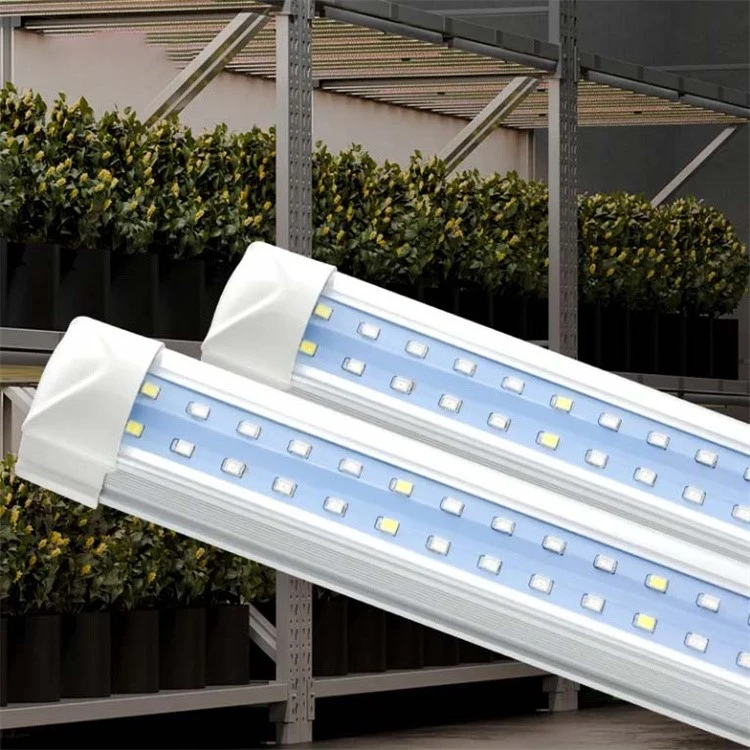
Key Factors Causing Light Attenuation in Commercial Planting Scenarios
Thermal Aging: The Primary Killer of LED Grow Light Lifespan
In commercial continuous operation scenarios, heat accumulation is the core factor accelerating LED chip aging and light attenuation. Professional optical research data shows that for every 10°C increase in LED chip junction temperature, the effective service life of the lamp will be halved, and the light decay speed will increase exponentially. Most low-cost commercial grow tubes adopt thin and simple iron shells or ordinary plastic heat dissipation structures, with poor thermal conductivity. Under long-term 16–24 hours continuous operation, heat cannot be discharged in time, resulting in continuous high junction temperature of chips.
Long-term high-temperature operation will cause irreversible damage to the LED chip luminescent layer and fluorescent powder, leading to gradual spectral deviation and reduced light transmittance. The most intuitive manifestation is that the grow light becomes dimmer year by year, the PPFD value continues to drop, and the original full-spectrum ratio is unbalanced, which cannot meet the photosynthetic matching needs of crops, resulting in slow growth and reduced yield. In large-scale vertical farms with dense lamp layout, the heat superposition effect is more obvious, and the light decay speed of ordinary grow lights is 2–3 times faster than the standard laboratory data.
Our commercial T8 grow tube solves the thermal decay problem from the structural source. It adopts high-purity thickened aluminum alloy integral heat sink, with large heat dissipation area and rapid thermal conduction speed. The optimized heat dissipation groove structure accelerates air convection, quickly takes away the heat generated by chip operation, and strictly controls the LED junction temperature below 85°C even in high-temperature and high-density planting environments. This stable thermal management system fundamentally avoids rapid light attenuation caused by heat accumulation and ensures long-term stable chip performance.
Environmental Erosion: Hidden Risks of High-Humidity Planting Environments
Commercial greenhouses, grow rooms, and vertical farms are always in high-humidity and dust-prone environments, which put forward higher requirements for the environmental adaptability of grow lights. Ordinary LED grow tubes mostly adopt non-sealed simple assembly structure with low protection grade. Moisture in the air easily penetrates into the lamp body, causing circuit board oxidation, solder joint aging, and chip damp damage; dust accumulation on the lamp surface will block the light-transmitting layer, reducing light transmittance and forming artificial light attenuation.
This kind of environmental attenuation is progressive and irreversible. In the first year of use, the light decay is not obvious, but after 1–2 years of operation, the light output will drop sharply, and the failure rate will increase significantly. Many growers mistakenly believe that the lamp is still usable when it is lit, but ignore the serious light attenuation problem, resulting in long-term low-efficiency crop growth and continuous loss of planting benefits. For commercial planting with annual output assessment, such hidden losses are far higher than the cost of lamp replacement.
This T8 commercial grow tube is equipped with IP40 industrial-grade dust-proof and moisture-proof protection, with an integral sealed lamp body structure. It can effectively block fine dust and moisture invasion, prevent internal circuit oxidation and damp aging, and adapt to long-term stable operation in high-humidity planting environments. The high-transmittance anti-yellowing PC lampshade will not age or fog for a long time, maintaining stable light transmittance and avoiding light attenuation caused by environmental pollution, greatly extending the effective service life of the lamp in commercial scenarios.
Unstable Drive: Accelerated Aging Caused by Current Fluctuation
Commercial planting bases have complex power supply environments, and voltage and current fluctuations often occur during peak power consumption. Low-end grow lights use inferior constant-voltage drive chips without over-current and over-voltage protection functions. Frequent current surges will impact the LED chips, resulting in gradual damage to the chip luminous unit, increased light attenuation, and shortened overall service life. In addition, inferior drive circuits are prone to stroboscopic light output, which not only causes plant light stress and affects growth rate but also accelerates the aging of electronic components.
High-quality commercial grow lights must be equipped with high-stability constant current drive systems to match long-term continuous operation. Our T8 full-spectrum grow tube adopts imported intelligent constant current drive chips, with built-in over-voltage, over-current, and short-circuit protection modules. It can automatically adjust the current and voltage according to the power supply environment, maintain stable and flicker-free light output for a long time, avoid chip impact damage caused by power fluctuation, effectively slow down electronic component aging and light attenuation, and ensure consistent light output performance throughout the lamp life cycle.
Product Lifespan and Light Attenuation Data: Professional Test Verification
Ultra-Long Effective Lifespan Data
Based on international standard aging test experiments and actual commercial planting feedback, our T8 commercial LED grow tube has an L70 effective lifespan of up to 50,000 hours, which is 2.5–3 times that of ordinary fluorescent grow tubes and 1.5 times that of low-end ordinary LED grow tubes. According to commercial planting operation standards, the actual service cycle is divided into multiple scenarios: under 12-hour daily light supplement for home and small-scale commercial planting, the lamp can operate stably for more than 11 years; under 16-hour standard commercial photoperiod operation, the effective service life exceeds 8 years; under 24-hour uninterrupted continuous operation of industrial vertical farms, it can maintain qualified photosynthetic light output for more than 5.5 years.
Different from the false lifespan marking of many products on the market, our 50,000-hour lifespan refers to the effective working hours that maintain L70 light output, not the nominal lighting time of complete lamp damage. Even after long-term operation, the lamp body can still work normally, and the light attenuation is controlled within the commercial qualified range, which truly realizes long-term and low-maintenance commercial lighting.
Industry-Leading Ultra-Low Light Attenuation Performance
After 50,000 hours of continuous aging testing, the lumen depreciation rate of this T8 grow tube is less than 30%, which means that the lamp can still maintain more than 70% of the initial PPFD value and spectral accuracy after long-term operation. In the first 25,000 hours of use, the light attenuation is less than 15%, achieving almost lossless light output; even after 40,000 hours of operation, the light decay is still controlled within 25%, far better than the industry average level of 40%–50% attenuation of ordinary products in the same cycle.
This ultra-low attenuation performance ensures that the full-spectrum ratio required for plant photosynthesis remains stable throughout the service life. There will be no spectral imbalance or insufficient light intensity in the later stage of use, ensuring consistent crop growth speed, yield, and quality. For commercial planting enterprises, it completely avoids the yield fluctuation and quality decline caused by light attenuation, and realizes standardized and stable planting production for many years.
Commercial Value: Cost Saving and Efficiency Improvement Brought by Low Attenuation and Long Lifespan
Reduce Long-Term Equipment Replacement Costs
Commercial planting operation costs include not only equipment procurement costs but also hidden costs such as lamp replacement, labor maintenance, and yield loss caused by light attenuation. Ordinary low-end LED grow tubes need batch replacement every 2–3 years due to severe light decay; fluorescent tubes need to be replaced every 1 year, resulting in continuous repeated procurement costs and high labor maintenance costs. For large-scale planting bases with hundreds or thousands of lamps, the annual replacement and maintenance expenses are extremely high.
Our T8 commercial grow tube with 50,000-hour ultra-long lifespan and ultra-low attenuation can achieve 5–8 years of maintenance-free stable operation after one-time installation. It greatly reduces the frequency of lamp replacement, saves a lot of material and labor costs for commercial growers, and avoids the economic loss caused by frequent equipment replacement affecting the continuous planting cycle. From the long-term operation perspective of commercial projects, its comprehensive cost performance is far higher than that of ordinary low-cost grow lights.
Stabilize Crop Yield and Avoid Hidden Planting Losses
The biggest hidden loss of light attenuation is the continuous decline of crop yield and quality. When the grow light decays seriously, the insufficient photosynthetic photon flux will lead to slow seedling growth, weak plant vigor, delayed flowering and fruiting, reduced fruit setting rate, and decreased crop nutrient accumulation. This kind of loss is invisible and long-term, which will continuously reduce the profit margin of commercial planting projects.
This product's stable low-attenuation performance ensures that the light intensity and full-spectrum ratio remain consistent throughout the whole growth cycle of crops. It can always provide efficient and accurate photosynthetic light energy stimulation for plants, maintain stable crop growth rate and yield, avoid production fluctuations caused by light source aging, and help commercial farms form standardized, large-scale, and high-yield planting systems. Stable yield and quality will greatly improve the market competitiveness and long-term profitability of planting products.
Optimize Commercial Planting Operation Efficiency
This T8 grow tube supports daisy-chain series connection, with up to 6 lamps connected in series, featuring plug-and-play and simple installation. Matching with long lifespan and low attenuation performance, it realizes one-time layout and long-term stable operation of commercial planting racks. There is no need for frequent lighting equipment debugging, replacement, and maintenance, which greatly simplifies the daily operation and management work of the planting base, reduces the technical threshold and labor pressure of operation and maintenance, and improves the overall operational efficiency of commercial projects.
How to Further Extend the Service Life of Commercial T8 Grow Tubes
Standard Installation and Reasonable Layout
In commercial installation, avoid excessive dense layout of lamps to prevent heat superposition and accelerated thermal attenuation. According to the planting rack height and crop growth height, keep a reasonable light irradiation distance to ensure uniform heat dissipation of the lamp body. Adopt standardized daisy-chain wiring to avoid circuit overload and current instability, and provide a stable working environment for long-term operation of the lamps.
Daily Maintenance and Environmental Management
Regularly wipe the surface of the lamp body to remove dust and impurities, maintain the maximum light transmittance of the lampshade, and avoid artificial light attenuation caused by dust accumulation. Control the humidity of the planting environment within a reasonable range to avoid long-term ultra-high humidity erosion. Regularly check the circuit connection status to ensure stable power supply and eliminate potential safety hazards such as poor contact and current surge.
Scientific Operation Cycle Setting
According to the growth characteristics of different crops, set a reasonable photoperiod, avoid long-term 24-hour non-stop operation under unnecessary conditions, and properly control the load of the lamp body. Reasonable intermittent power supply can help the lamp body dissipate heat fully, delay chip aging, and further extend the effective service life of commercial grow tubes.
Conclusion
The service life and light attenuation performance of commercial LED grow tubes are the core factors that determine the long-term operational value of indoor planting projects. Ordinary low-end grow lights only pursue low procurement costs but have serious light attenuation and short effective service life, bringing continuous hidden losses such as frequent replacement, high maintenance costs, and unstable crop yield to commercial growers. In contrast, our commercial-grade T8 full-spectrum LED grow tube relies on high-purity aluminum thermal management system, IP40 industrial protection, stable constant current drive technology, and high-quality LED chips, achieving 50,000-hour ultra-long L70 effective lifespan and ultra-low light attenuation of less than 30% in the whole life cycle.
This product fundamentally solves the pain points of rapid aging and severe light decay of traditional commercial grow lights, maintains long-term stable photosynthetic light output and spectral accuracy, ensures continuous and efficient growth of various crops, and greatly reduces the long-term operation and maintenance costs of commercial planting. For modern vertical farms, commercial greenhouses, and large-scale seedling breeding bases, this low-attenuation, long-life commercial T8 grow tube is a high-cost-performance and high-reliability professional lighting solution, which can effectively stabilize planting yield, improve economic benefits, and help commercial planting projects achieve long-term sustainable and profitable operation.

How To Cooperate With Us?
Since we have our own facilities, we are pleased to have complete control over the production process and the quality of our goods. We are committed to giving our clients the finest prices since we are manufacturers rather than just brokers. We encourage buyers to see our samples first since we are certain that the cost and calibre of our items are transparent. Our dedication to excellence and client happiness motivates us to consistently provide superior products.
Our address
3rd Floor, 5th Building, Hebei Industrial Park, Hualian Community, Longhua District, Shenzhen, China