LED Tubes That Cut Out Blue and Violet Light – What They Are and Why They Matter
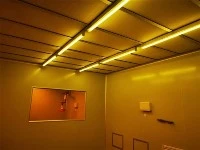
Have you ever noticed those yellowish LED tubes and wondered what they're really for? They're not just about creating a warm, cozy atmosphere – in many places, their main job is actually to not disturb certain sensitive processes.
Today, let's talk about LED tubes that are designed to deliberately filter out wavelengths shorter than 500 nanometres – that is, the blue and violet part of the spectrum. The light they emit is a pure, warm yellow, which is why they're often called "yellow-light tubes".

🟡 How do they work? The principle is actually quite simple.
Think of it as putting a pair of "sunglasses" on the light. There are two main ways to achieve it:
- Control at the source: Special phosphors and materials are used in the LED chip or package so that the light is naturally concentrated in the yellow band around 570–590 nm.
- Physical filtering: An optical coating or a yellow PC (polycarbonate) cover on the tube absorbs or reflects any light below 500 nm. Some technologies even achieve "zero" short‑wavelength output below 495 nm.
With this double protection, the light that finally comes out is pure yellow, completely free of blue or violet components.
🎯 Where do these "golden rays" shine?
You might be surprised at how many places rely on this kind of lighting:
- 🏭 Precision manufacturing (semiconductors, PCBs, photolithography): This is one of the most critical applications. In chip and circuit board production, photoresists are extremely sensitive to light below 500 nm. If stray blue light leaks into the workshop, it's like exposing a photo twice – fine circuit patterns become blurry, leading to expensive scrap. Yellow‑light tubes act as a "safety colour", ensuring flawless production.
- 🦷 Medical and dental (handling light‑cured materials): You're probably already familiar with this. Dental resins and similar materials start to harden when exposed to certain blue or UV wavelengths. If a dentist is preparing or filling a cavity under ordinary lights that contain those wavelengths, the material may harden prematurely (called "early polymerisation"), affecting the treatment. These blue‑free yellow lights give clinicians a safe working window.
- 🎨 Cultural heritage conservation (museums, archives, galleries): Many precious paintings, manuscripts and artefacts fade, age or become brittle under long‑term exposure to blue and UV radiation. By using these tubes, museums and archives can illuminate exhibits while doing their utmost to protect fragile treasures.
- 🦟 Insect repellent and pest control: Many insects are attracted to blue‑violet light. Yellow light, on the other hand, is almost invisible to them. So these tubes are also popular in outdoor areas or specific indoor spaces where you want to reduce insect intrusion.
- 📖 Healthy lighting and bedtime reading: Blue light suppresses melatonin production and can disrupt sleep. These nearly blue‑free, spectrally pure tubes produce very soft light that reduces eye strain, making them a great choice for children's rooms or as reading lights before sleep.
⚠️ A few things to keep in mind before using them
As useful as they are, these tubes have some distinct characteristics:
- Colour rendering (CRI) is generally low: Because the spectrum is narrow, colours look distorted – everything tends towards yellow. The colour rendering index (Ra) typically measures between 28 and 55 in real tests. So they are absolutely not suitable for tasks where colour accuracy is important, such as selecting fabrics or matching printing colours.
- "No blue light" does not mean "extra bright": Although luminous efficacy can be around 100 lumens per watt, the visual impression of yellow light may not feel as bright as white light of the same wattage. When buying, refer to the actual luminous flux (lumens) rather than just the power rating.
- "UV‑free" claims need to be checked against the test range: Many products say "UV‑free", but it's worth checking whether the test report actually covers wavelengths below 380 nm. If you have strict UV‑free requirements, ask the manufacturer for a report that covers the full 200‑400 nm range.


💎 Wrapping up
LED tubes that "eliminate wavelengths below 500 nm" are essentially specialised tools designed for specific needs.
They sacrifice the high colour rendering that general lighting pursues, but in return they offer absolute safety in precision manufacturing, medical procedures, and cultural heritage preservation. Their warm yellow glow has also found a unique place in pest control and health‑oriented lighting.
So next time you see a yellow light, you might pause and think about the precision chip it's protecting, the dental filling it's safeguarding, or the ancient painting it's preserving. The world of lighting can be more interesting than it first appears.