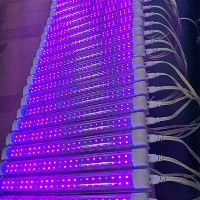
Not every T8 tube on the market is built for the same job. Somewhere between a regular white-light LED tube and a specialty UV lamp sits a category that a lot of buyers get confused about: the 395nm UV integrated T8 LED tube. It looks like an ordinary fluorescent-style tube, but the light it puts out - and the jobs it's designed for - are completely different. If you've been comparing quotes and wondering why 395nm UV tubes cost more, arrive with different specs, and get recommended for different use cases than standard LED tubes, this article breaks down exactly what sets them apart.
What 395nm UV Light Actually Is?
395nm sits at the very edge of the visible spectrum, right where violet light transitions into UVA. It's technically classified as "near-UV" or "black light," which is why 395nm tubes emit that familiar purple-blue glow rather than the invisible output of shorter-wavelength UV-C lamps used for sterilization.
This particular wavelength isn't arbitrary. It's chosen because it's efficient at triggering fluorescence in certain inks, resins, and coatings, while still being long enough to avoid the ozone generation and stricter safety handling that come with UV-C or deep UV-B sources. In practical terms, that makes 395nm a workable wavelength for everyday industrial and commercial settings, not just lab environments.
What "Integrated" Means in an Integrated T8 Tube
The word "integrated" refers to the driver placement, not the wavelength. In a standard fluorescent-style setup, the ballast is a separate component mounted inside the fixture, feeding power to the tube. An integrated T8 LED tube builds that driver directly into the tube body itself.
For a 395nm UV tube, this matters more than it might for a regular lighting tube. UV LED chips are more sensitive to current fluctuation than standard white LEDs - inconsistent current shortens their effective lifespan and can cause visible flicker or output drop-off over time. Housing the driver inside the tube lets the manufacturer match it precisely to the UV chip array, rather than relying on whatever ballast happens to already be in a customer's fixture.
How It Differs from a Standard T8 LED Tube
On the surface, a 395nm integrated tube and a regular T8 LED tube share the same form factor - same length, same pin base, same general shape. The differences show up once you look past the housing:
Light spectrum: A standard T8 tube outputs white light across the visible spectrum for illumination purposes. A 395nm tube outputs a narrow band centered on UVA, which is not intended for general lighting at all.
Chip selection: UV tubes use UV-specific LED dies, which are typically less efficient at converting electricity to light than white LED chips, meaning UV tubes often run at lower lumen-equivalent output for the same wattage.
Lens material: Many 395nm tubes use a lens or diffuser designed to pass more UV wavelength through rather than diffuse it evenly, since scattering isn't the goal - concentrated output on a target surface is.
Driving current: Because UV chips degrade differently than white LEDs under thermal stress, the integrated driver is usually tuned with tighter current regulation to protect long-term output consistency.
Intended install base: Since these tubes are rarely retrofitted into general lighting fixtures, they're most often paired with dedicated UV fixtures or inspection booths rather than office or warehouse lighting.
Where 395nm UV Tubes Get Used
395nm tubes show up across a fairly specific set of industries rather than general commercial lighting:
UV curing for inks, adhesives, and coatings in printing and packaging lines, where 395nm is common because it works with a broad range of UV-curable formulations without the higher cost of shorter-wavelength systems.
Inspection and quality control, such as checking for cracks, leaks, or contamination using fluorescent dye penetrant methods in manufacturing and automotive settings.
Currency and document verification, where UV-reactive security features on banknotes, IDs, and tickets fluoresce under near-UV light.
Pest attraction and insect trapping, since many flying insects are drawn to near-UV wavelengths, making 395nm tubes a common component in glue-board or electric insect traps.
Mineral and gemstone fluorescence, used by hobbyists and geologists to identify certain minerals that glow under UVA exposure.
Specs Worth Checking Before You Order
Because "395nm UV LED tube" isn't a single standardized product, spec sheets can vary a lot between suppliers. A few things worth confirming before placing an order:
Actual peak wavelength - some tubes labeled "395nm" have a peak closer to 385nm or 405nm, which matters if your application (like ink curing) is wavelength-sensitive.
Irradiance (mW/cm²), not just wattage - this tells you the actual UV intensity delivered at a working distance, which is the number that determines curing speed or fluorescence brightness.
Driver IP rating, especially for tubes going into wash-down or high-humidity environments like print shops.
Thermal management design - UV chips run hotter under sustained use, so aluminum-bodied tubes with adequate heat dissipation tend to hold output longer than plastic-bodied versions.
Base and socket compatibility - confirm whether it's a single-ended or double-ended power connection, since this affects fixture rewiring requirements.
Summary
A 395nm UV integrated T8 LED tube shares its shape with an ordinary LED tube but serves a fundamentally different purpose. The integrated driver protects the more delicate UV chips from current instability, the narrow 395nm output is tuned for fluorescence and curing rather than illumination, and the applications - from ink curing to security inspection to insect trapping - reflect that specialized role. Understanding these distinctions makes it much easier to read a spec sheet correctly and avoid ordering a tube that looks right on paper but isn't matched to the actual working wavelength or intensity your application needs.
Still working out which 395nm UV tube spec fits your application, or need a sample tested against your existing fixtures? Reach out to our team with your project details - we're happy to walk through wavelength, irradiance, and compatibility questions and help you find the right fit.
https://www.benweilight.com/lighting-tube-bulb/10w-60cm-395nm-uv-integrated-t8-led-tube.html