What do RGB and RGBW stand for?
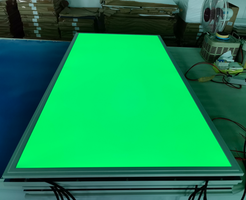
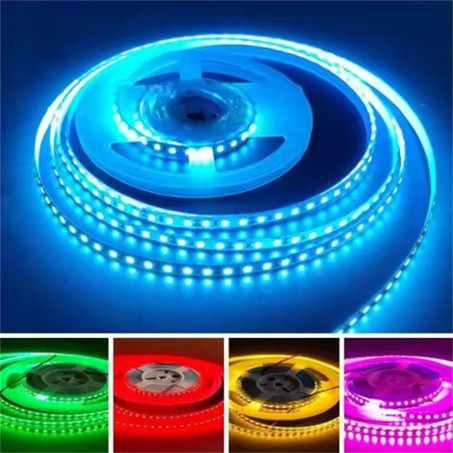
RGB lighting fixtures consist of three LED chips that emit the primary colors: red, green, and blue. Their integrated circuits adjust the current flowing through these three RGB LED chips to change their light intensity. By varying the mixing ratio of these three primary colors, they can produce a wide range of colors. This enables them to synthesize all colors within the trichromatic triangle-approximately 16.78 million colors, including white light.
The light intensities of the three primary color LEDs differ even when operating at the same rated current. To generate white light, each color requires a different driving current. However, current control has limitations because the relationship between current and light intensity is not always linear. Ultimately, perfect white light cannot always be achieved. Additionally, the white light produced by RGB fixtures is usually relatively dim.
Subsequently, RGBW lighting was developed, incorporating an additional white light chip. These four-color RGBW LED chips deliver purer colors and brighter white light.
RGB vs. RGBW: 6 Key Differences
RGB and RGBW Controllers
Controlling RGB and RGBW LED Lights with Remote Controls
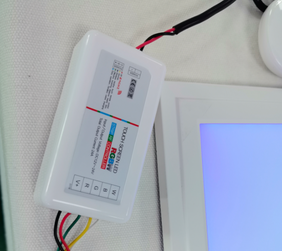
RGBW controllers offer more color channels than RGB controllers because RGBW lights feature four chips, while RGB lights have three. RGBW controllers can manage RGB LED strips and typically have a higher rated power than RGB controllers.
Both RGB and RGBW controllers operate using PWM (Pulse-Width Modulation) signals. In RGB controllers, PWM adjusts the brightness of the red, green, and blue channels. In RGBW controllers, PWM regulates the brightness of all four color channels: red, green, blue, and white.
The input for RGB controllers usually comes from user commands via buttons or knobs. These commands are processed to generate control signals, which then produce PWM modulated signals through the circuit and are sent to RGB fixtures via the output interface.
By adjusting the duty cycle (the ratio of on-time to off-time) of the PWM modulated signal for each channel, the controller can change the brightness of RGB lights. For example, increasing the duty cycle of the red channel makes the red light brighter. When the PWM signal intensities of the red, green, and blue channels are equal, the fixture emits white light.
Controlling RGB and RGBW Lights with DMX 512 Systems
Each output circuit in a DMX control system supports up to 512 channels. The maximum number of devices that can be controlled per port depends on the number of channels each device occupies. Since RGB lights have 3 chips and RGBW lights have 4 chips, a single DMX 512 port can connect approximately 512/3 ≈ 170 RGB light beads and 512/4 = 128 RGBW light beads respectively.
Brightness
The white light of RGBW lights is emitted independently by the white LED chip, unrelated to the combination of red, green, and blue light. This allows them to produce brighter white light.
Based on the spectral characteristics of RGB and RGBW light, we observe that RGBW lighting produces light closer to natural light. This means the light accurately reflects the true colors of objects without introducing color distortion. Equipped with a white LED chip, RGBW lights can also generate a wider range of neutral colors such as gray and brown by adjusting the ratio of red, green, and blue light. This enables the lighting to reproduce color details more precisely. RGB lights have a Color Rendering Index (CRI) below 50, while RGBW lights have a CRI exceeding 90.
Color Temperature
RGB LEDs produce white light by combining equal amounts of red, green, and blue light, resulting in a higher color temperature, usually ranging from 5000K to 6000K. In contrast, RGBW LEDs adopt a warm white chip that can produce softer white light with a color temperature of approximately 3000K–3500K. For higher color temperatures, RGBWW chips add a cool white chip to the RGBW configuration, achieving cool white light of up to 6500K.
Power Consumption
Since the white chip in RGBW lights can emit light independently, their overall power consumption is lower. Compared to traditional RGB lights, RGBW lights consume less electricity at the same brightness level, effectively saving energy. RGBW lights also have better light transmittance and a larger light-emitting surface, resulting in higher luminous efficiency than RGB lights.
Applications
RGB and RGBW LED lights have similar applications, but RGBW lights offer broader applicability.
Both RGB and RGBW lights can be used for stage lighting, decorative lighting, facade lighting, commercial lighting, and more, providing vibrant illumination and diverse lighting effects. In addition to these uses, RGBW lights are also suitable for home interior lighting, offices, and similar settings. They provide colored lighting while also offering practical white light illumination.